Creating Clarity around Communal Dining Formats
“Food Hall” has become one of the most overused labels in hospitality—sometimes used accurately, sometimes used aspirationally, and sometimes used simply because it sounds good. In practice, the term now covers everything from chef-driven, community-centered destinations to renovated ghost kitchens with a walk-up window and a new logo.
This blurring matters.
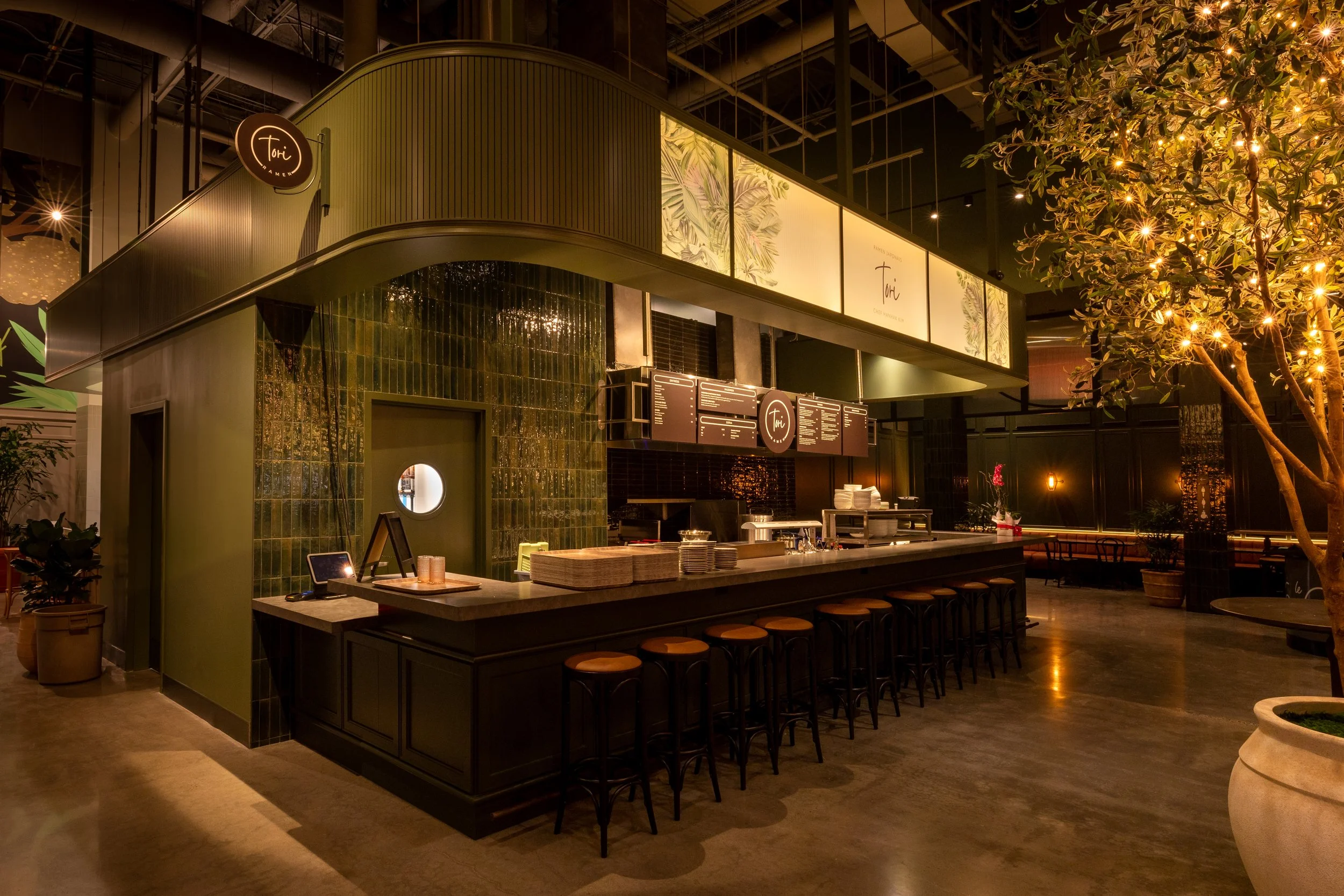
Le Fou Fou, Montreal
When guests are unsure of what to expect, trust in the experience erodes. When developers chase a trend without a clear operating model, their projects tend to underperform. And when genuinely great communal dining destinations get lumped into the same bucket as totally unrelated models, the entire category loses its meaning.
Our team at Onset Hospitality has helped deliver some of the world’s most respected food hall destinations, including the Time Out Market portfolio, Riyadh’s Al Mamlaka Social Dining, and the all-new Le Fou Fou in Montréal. Over that time, we’ve learned that what we think of as a food hall isn’t defined by how many chefs fit under one umbrella. It’s defined by thoughtful curation, a respect for culinary craft, and community energy—supported by a professional operating model that makes the whole ecosystem work.
And we feel that reserving the term ‘Food Hall’ for this kind of experience maintains the integrity of these increasingly popular dining and entertainment destinations.
Our Definition of a Food Hall
For those working in the field, a food hall is a curated, hospitality-driven destination built around best-in-class local operators, where food is made primarily on-site, the environment is cohesive and purpose-built for discovery, and the experience is supported by professional management, programming, and a bar that anchors the experience.
In other words, it isn’t just “a lot of options.” It’s a lineup with standards, a room with identity, and an operating model designed to create repeat visits—because people don’t just come to eat. They come to explore, be entertained, and spend time.
If you want a simple test: a food hall should feel like a destination, not an amenity.
Why the distinction matters now
As the food hall category has grown globally, it’s also developed a few lookalikes. Food courts have evolved and improved. Single-operator “dining halls” have borrowed the visual cues. Delivery-forward platforms have adopted food hall language to describe something more logistical than communal.
Many of these formats are genuinely good at what they’re built to do. The issue isn’t quality—it’s clarity. A food court can be a strong solution. A ghost kitchen can be incredibly convenient. A single-operator venue can be polished and efficient.
But they are not the same promise, and they are not the same trajectory.
Food halls, at their best, are moving toward stronger local identity, more experiential programming, and more “made-here, made-now” energy. That is the direction guests reward—and the direction the most durable projects are taking.
The non-negotiables of a true Food Hall
1) A hand-curated lineup—not a leasing exercise. A real food hall starts with a point of view. The vendor mix should be curated with intent, not assembled based on whoever is available and creditworthy in the moment. The goal is to build a roster that feels deliberate—balanced across cuisines, price points, dayparts, and guest motivations—while still leaving room for fun and excitement.
Curation is also how you protect quality and create a harmonious community of like-minded chefs and restaurateurs. It sets a standard that keeps the hall from drifting into a generic collection of “good enough” operators.
2) Best-in-class local operators—not chains or licensed recipes. Fast casual chains have their place. But the heart of a food hall is local talent: operators with craft, story, a local following, and credibility in their market. The “why” of a food hall is discovery—trying the place you’ve heard about, the chef you’ve been meaning to visit, the cuisine that feels rooted in the city rather than imported from elsewhere. Similarly, licensing recipes from big-name chefs or restaurateurs and mass-producing them in an off-site kitchen undermines expectations of freshness and authenticity.
When the roster is built around local standouts, the hall gains authenticity—and authenticity is one of the most bankable forms of differentiation in modern dining.
3) A cohesive environment with its own identity. The space itself matters. A food hall should feel like a single destination with multiple expressions—not an extension of a mall, a campus commons, or a pass-through corridor. Cohesion comes from design, yes, but also from signage strategy, lighting, seating typologies, sound, and flow. It comes from how the bar is positioned. It comes from how guests intuitively understand the room and bhow the room is purpose built for different experiences throughout the lifespan of the food hall.
When a food hall reads as “its own place,” it invites people to arrive on purpose—and stay longer once they do.
4) Made-To-Order food — ideally cooked in front of the guest. A defining element of a great food hall is the immediacy of it: the aroma, the sizzle, the movement behind the counter. Food implies theatre when it’s made close to the guest, and that theatre becomes part of what people come for.
When production is largely industrialized off-site, and the on-site operation becomes mostly reheating and assembly, you may still serve something tasty—but the experience shifts. It becomes less about craft and more about distribution. And that typically moves the format away from what guests increasingly seek in a destination: great food, freshness, and a sense of place.
5) Programming and activation. A food hall shouldn’t be a room that simply fills up at lunch. The strongest halls become community hubs, with events and activation that give guests reasons to return beyond routine meals. That might include live music, chef demonstrations, pop-ups, seasonal markets, sports viewing moments, cultural partnerships, or neighborhood-led events.
Programming isn’t an accessory. It’s a strategic lever: it builds identity, expands dayparts, increases dwell time, and turns a visit into a habit.
6) Professional management and a backbone of true hospitality. This is one of the most misunderstood pieces. Food halls don’t run themselves—and they shouldn’t ask vendors to shoulder the entire guest experience alone. A true food hall has professional management coordinating operations, marketing, standards, vendor relations, cleanliness, programming, and day-to-day guest experience.
That “serviced” layer is also what keeps the hall consistent without flattening the individuality of each operator. It’s the difference between a room of tenants and a unified hospitality destination.
7) A world-class beverage experience
Finally, there needs to be a compelling beverage experience, and it needs to be real. Not an afterthought, not a token tap wall tucked in a corner. For much of the world, a properly designed and operated bar is the social engine of a food hall. It extends the day into the evening, supports programming, increases dwell time, and gives the room a sense of occasion.
In many best-in-class projects, the beverage program isn’t just a revenue line—it’s a central organizing feature of the guest experience.
Food Hall vs. Food Court
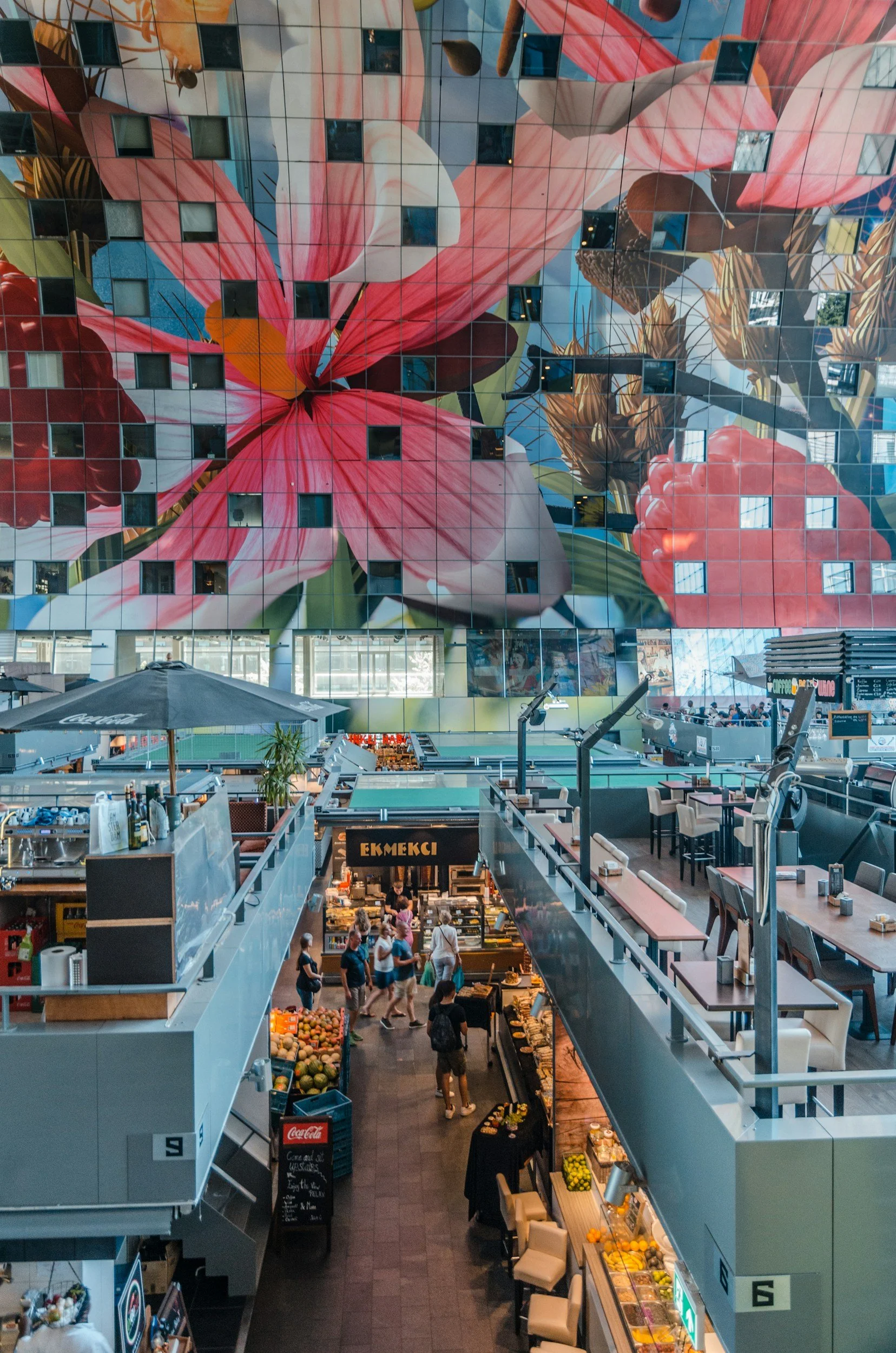
A food court is typically built to feed people efficiently inside a larger environment—mall, campus, airport, or mixed-use complex. It prioritizes speed, familiarity, and convenience, and it often depends on larger brands or quick service chains that can handle volume and standardized operations.
A food hall is built to host people. It prioritizes discovery, craft, atmosphere, and community energy. It is not merely a place to eat near other places—it is the place.
Both formats can be successful. They simply serve different purposes. And the food hall category, as it matures, is increasingly defined by destination thinking rather than utility.
Dining and Restaurant Halls – Close Cousins
Some venues resemble food halls visually but operate differently:
Single-operator dining halls often present multiple counters, but one operator controls the full program. When done well, they can be polished and effective, but they typically can’t replicate the authenticity that comes from a roster of independent specialists.
Restaurant halls are another branch of the same family tree—multiple operators under one roof with more traditional service rhythms and clearer restaurant boundaries.
These can be great experiences. They’re just not the same model as an operator-led, curated food hall ecosystem.
What about Wonder
Wonder is an example of an aggressive and scalable multi-unit F&B platform that markets itself as a Food Hall. While it is in an interesting model : convenient, broad in selection, and designed around off-premise and pickup needs, it doesn’t come close to our definition of a food hall.
That’s not a criticism. It’s a category distinction.
In our opinion, a true food hall is rooted in on-site craft, communal energy, and local operator identity, supported by a destination environment and programming. Wonder’s delivery-first, commissary model is rooted in distribution efficiency and menu breadth, with production occurring outside the guest’s view and outside the building itself.
Both can succeed. The difference is what they’re built to deliver—and where the food hall industry is going. The future of food halls points toward greater experientiality, deeper locality, stronger programming, and more reasons to gather. Convenience-led platforms and food courts can be excellent solutions, but they don’t represent the full promise of the food hall destination model.
If you want a true Food Hall, build it with intent—and build it with experts
A food hall isn’t a design style or a tenant plan. It’s an ecosystem: operator selection, operational strategy, bar program, flow and seating design, guest experience standards, marketing and events, and day-to-day management—all working together.
That’s why expertise matters.
If you’re serious about creating a food hall that becomes a destination and a community hub, work with a team that has delivered best-in-class examples. Onset offers the expertise and vision to make the Food Hall experience compelling, durable, and financially sound.